


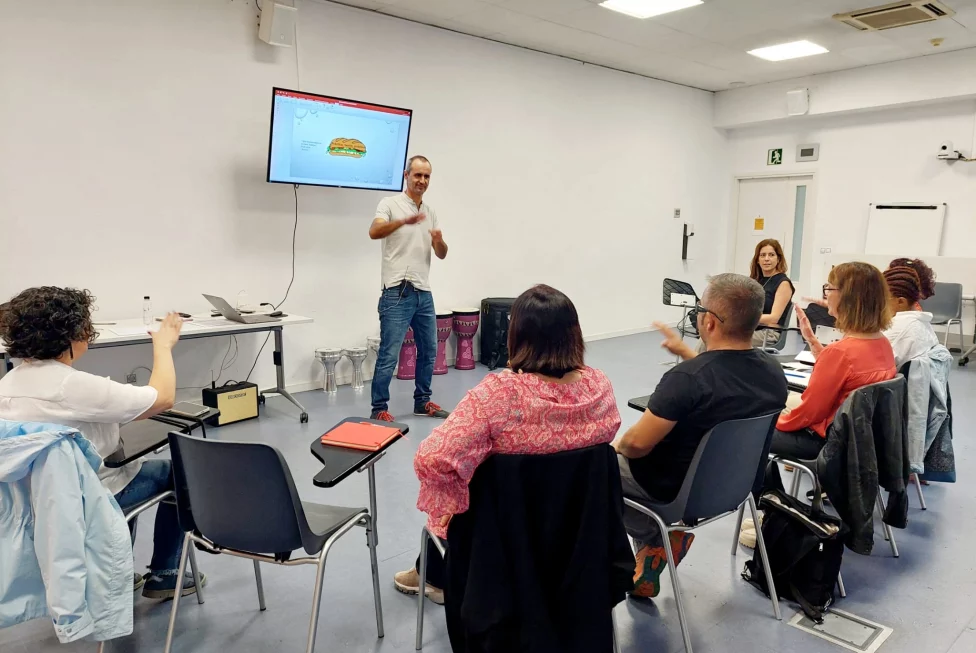
La integration of new teams is one of the most important processes within any organisation. Bringing new people into a company is much more than explaining what their responsibilities will be or introducing them to their colleagues. Whether it is a newly created team or a new member joining an established team, this process has a direct impact on motivation, the sense of belonging and, ultimately, the organisation’s performance.
Companies dedicate many hours to defining onboarding processes, technical training and informative meetings. All of this is essential. However, a fundamental aspect is often left aside: human connection.
For a team to function, it is not enough for people to know the company’s objectives. They also need to learn how to listen to each other, trust one another and feel that they are part of the same project.
This is where music and, especially, percussion can provide extraordinary value.
When a team is not yet a team
It is common for new teams to go through an initial phase in which each person observes their environment before actively participating.
- Who leads?
- How are decisions made?
- What is the level of trust between colleagues?
- What is the real company culture beyond what the onboarding manual says?
During this period, certain natural insecurities appear. Some people tend to speak little. Others prefer to observe. There are also those who try to quickly demonstrate their abilities.
It is all part of the process.
The problem appears when this phase lasts too long.
A team that has not truly got to know each other tends to communicate less, share fewer ideas and work with more caution than necessary.
That is why many organisations decide to accelerate this process through team-building activities.
Music removes many barriers
When a percussion activity is proposed, a first reaction often appears:
“I don’t have rhythm.”
It is a very common phrase.
And it is also one of the first barriers to disappear.
The percussion used in team-building activities is not intended to create musicians. It is intended to create shared experiences.
You do not need to know how to read music.
You do not need previous experience.
There are no exams or individual performances.
You simply need to listen, participate and let yourself be guided by the group’s rhythm.
This places everyone at the same starting point.
The director and the person who has just joined the company share exactly the same challenge.
And this creates an equality that is very difficult to achieve in other contexts.
Listening before acting
One of the most important skills within any organisation is listening.
Not just listening to words.
Listening to tempos.
The silences.
The working rhythms.
The needs of others.
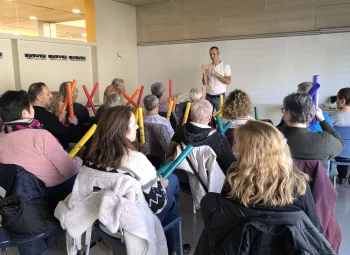
When a group performs a body percussion sequence or builds a piece with Boomwhackers tubes, they quickly discover that playing louder or faster does not help.
What really makes music work is listening to the whole group.
Interestingly, this is exactly what happens within a company.
The most efficient teams are not necessarily those with the best individual professionals.
They are those that have learned how to coordinate.
A universal language
In international companies, people from very different cultures work together.
Languages.
Experiences.
Training backgrounds.
Ways of communicating.
Music has a huge advantage: it does not need translation.
A pulse is the same in Barcelona, Berlin or Boston.
That is why rhythmic activities work particularly well in multicultural teams.
Within just a few minutes, many of the barriers that usually affect verbal communication disappear.
The importance of play
Adults often stop playing too soon.
When we enter a company, everything becomes serious.
Meetings.
Objectives.
Results.
Schedules.
But playing continues to be one of the most effective ways to learn.
When an activity is well designed, people laugh, make mistakes, try again and celebrate the group’s small achievements.
Without realising it, they are building trust.
And trust is the foundation of any high-performance team.
The metaphor of rhythm
A percussion activity is much more than music.
It is a metaphor for how a team works.
Each person has a role.
Each contribution is important.
There are moments to lead.
There are moments to follow.
There are silences as important as sounds.
When one person speeds up too much, the group notices.
When someone stops listening, the result changes.
When everyone shares the same pulse, a sense of cohesion appears that is very difficult to explain with words.
These situations allow teams to generate very useful reflections about their real way of working.
Body percussion and Boomwhackers
Two of the most commonly used tools in this type of activity are body percussion and Boomwhackers tubes.
Body percussion transforms the body itself into an instrument.
Through clapping, gentle chest taps, thigh strikes or small coordinated movements, the group progressively builds rhythmic patterns.
It is a highly dynamic discipline, ideal for activating attention and generating energy.
Boomwhackers tubes, on the other hand, introduce a very visual and collaborative element.
Each tube produces a different note.
Individually, they have little meaning.
Together, they create surprising melodies and harmonies.
It is a perfect metaphor for any organisation: value does not emerge from individuals alone, but from coordination.
Beyond the day of the activity
A good teambuilding activity does not end when people return to their desks.
Shared experiences create common memories.
Days later, it is common to hear comments such as:
“Do you remember when we managed to create that rhythm?”
That experience becomes a positive reference point within the team’s history.
It is a small detail.
But these small details are what build company culture.
Corella Music Experience
At Corella Music Experience we use rhythm as a tool to connect people.
Each session is designed so that participants experience concepts such as active listening, coordination, trust and teamwork first-hand.
We do this through disciplines such as body percussion, Boomwhackers tubes, drum circles and activities inspired by TaKeTiNa and team coaching.
No musical knowledge is required.
The focus is not the music.
The focus is the people.
Each activity is adapted to the organisation’s objectives and the participants’ profile, whether it is a newly formed team, a department incorporating new professionals or a company looking to strengthen its cohesion.
An investment in people
Organisations are constantly changing.
New professionals arrive.
New departments are created.
Teams merge.
All of this requires building relationships of trust in a short period of time.
Investing in the integration of new teams is not a luxury. It is a way to accelerate communication, facilitate relationships of trust and build more cohesive teams.
According to Gallup, an exceptional onboarding experience is key to creating an emotional connection between new professionals and the organisation, a decisive factor in increasing engagement, integration and team performance.
Because, ultimately, companies are not built only by processes or technological tools.
They are built by people.
And when people learn to listen to each other, coordinate and create together, rhythm stops being just music.
It becomes a new way of working.
If your organisation is incorporating new professionals or you want to strengthen team cohesion, Corella Music Experience offers a participatory, experiential experience adaptable to any business environment.
Sometimes, one hour sharing rhythm can do more for a team than many meetings.