


Music has been part of our lives since long before we learn to read or write. Rhythm, voice, clapping and movement are natural forms of expression that we can all experience, regardless of our musical experience.
For this reason, hiring a music workshop for schools can be a different way of introducing music into the classroom while also developing skills such as coordination, listening, creativity, participation and group cohesion.
But what should a good music workshop include? What activities can be carried out with students of different ages? And what should you consider before hiring one?
In this article, I explain the main aspects that I consider important when incorporating a participatory musical experience into a school or secondary school.
What is a music workshop for schools?
A music workshop for schools is an educational and participatory activity in which students learn and experiment with music through practice.
It is not necessarily about learning to play an instrument in the traditional way. A workshop can use the body, voice, everyday objects or simple instruments to discover concepts such as the pulse, rhythm, coordination, dynamics, listening or collective creation.
This characteristic makes workshops particularly interesting for educational centres looking for a musical activity in which the whole group can participate at the same time.
The idea is simple: students do not need to have any musical knowledge before they start. The workshop begins with accessible activities and progressively increases in complexity.
Why hire a music workshop for a school?
A musical activity can go far beyond entertainment. When it is designed as a participatory experience, rhythm becomes a tool for working on different dimensions of learning.
1. Because all students can participate
One of the major difficulties with some musical activities is that not all students start at the same level.
In contrast, many rhythm-based activities allow students to start from scratch. A clap, a step, a stomp or a simple sequence can become the first building block of a collective musical creation.
This allows students with musical experience and students who have never studied music to share the same activity.
2. To develop coordination and attention
Following a rhythmic pattern requires students to listen, observe and react. Students have to pay attention to what they are doing themselves and also to what the group is doing.
When different people have to maintain a common rhythm, coordination stops being an individual matter and becomes a shared experience.
3. To stimulate creativity
Music is also about creation. A workshop can give students the opportunity to experiment with sounds, combine rhythms, invent sequences and discover what happens when different musical patterns come together.
It is not always necessary to aim for a perfect performance. In many cases, it is more interesting to allow room for experimentation and let students discover that they can create music too.
4. To encourage active listening
In a collective rhythmic activity, listening is just as important as producing sound.
If one student speeds up while the rest maintain the pulse, the activity changes. If someone comes in too early, the group notices. For a sequence to work, students need to learn to listen to others and adapt to the group as a whole.
This is one of the characteristics that makes rhythm an interesting tool for developing coordination and communication within the group.
5. Because it enables experiential learning
Some concepts are better understood when they are experienced rather than simply explained.
In a music workshop, students do not just listen to an explanation about rhythm: they practise it. We do not just talk about coordination: they try to coordinate with one another. We do not just explain what working as a group means: they have to do it to achieve a musical result.
This practical dimension is one of the main values of music workshops for schools.
What benefits can a music workshop provide for students?
The benefits depend on the students’ age, the methodology, the duration and the objectives of the activity. That is why it is important not to present every musical activity as a universal solution.
However, a well-designed activity can help develop:
- Motor coordination.
- Attention and concentration.
- Active listening.
- Creativity and expression.
- Participation.
- Cooperative work.
- Confidence within the group.
- Body expression.
- Rhythm perception.
- Adaptability.
Educational research has also studied the impact of certain musical interventions in school settings. For example, the Education Endowment Foundation evaluated a music education programme implemented in 64 schools and indicates that there is evidence of potential benefits in some educational outcomes, while highlighting that further evidence is still needed to establish general conclusions. Read the Education Endowment Foundation’s evaluation of First Thing Music.
What activities can be included in a school music workshop?
A workshop does not have to be limited to playing instruments. In fact, one of the most interesting possibilities is to combine different ways of producing and experimenting with rhythm.
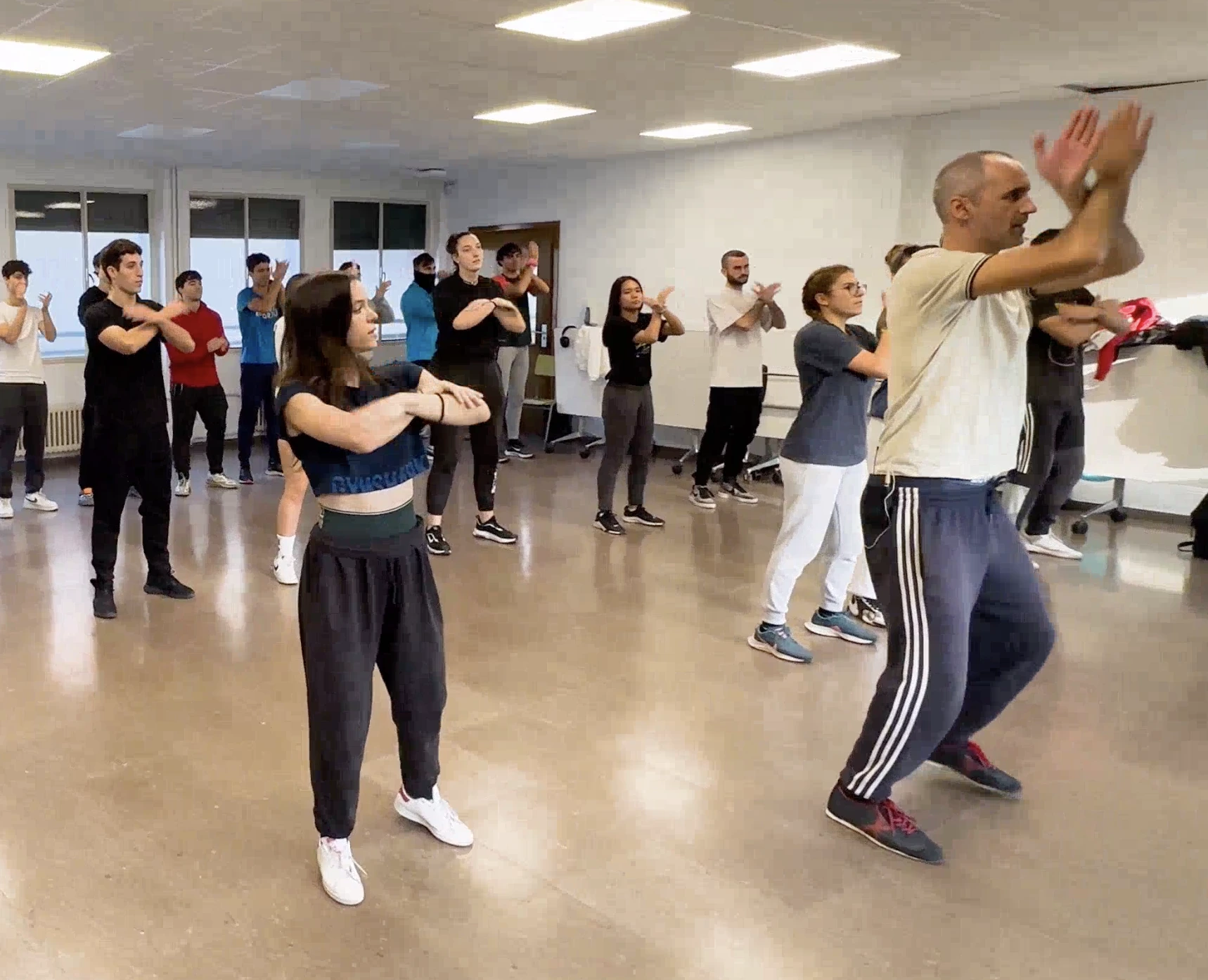
Body percussion
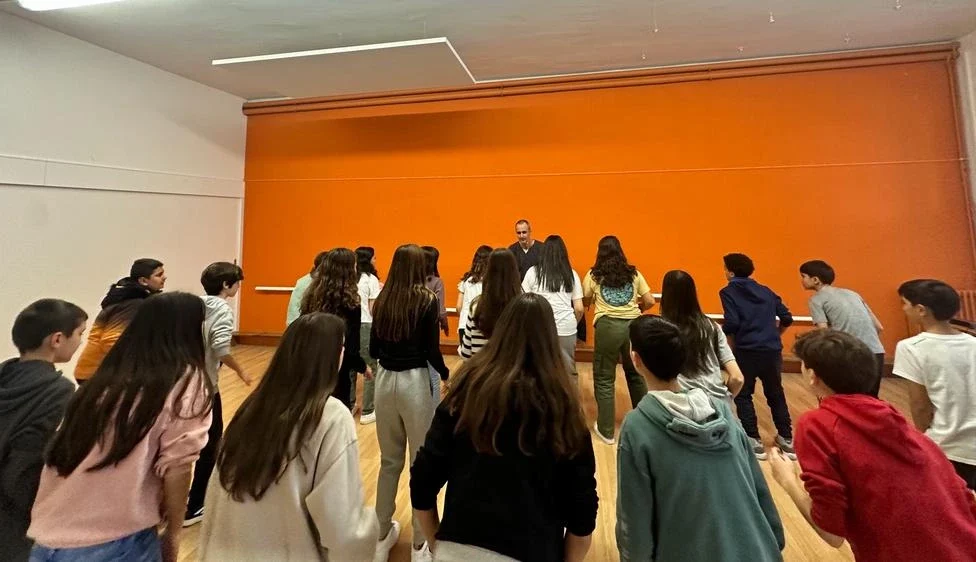
Body percussion turns the body itself into an instrument. Hands, feet, voice and different movements can be used to create rhythmic patterns without the need for musical instruments.
It is a particularly accessible activity because students can start with very simple movements and gradually build increasingly complex sequences.
It also allows students to work on rhythm, movement, coordination and listening simultaneously. In a group activity, the goal is not only for each student to perform their pattern correctly, but to make sure that all the patterns work together.
Boomwhacker Orchestra
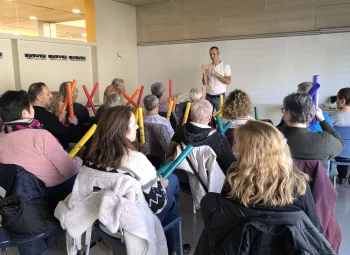
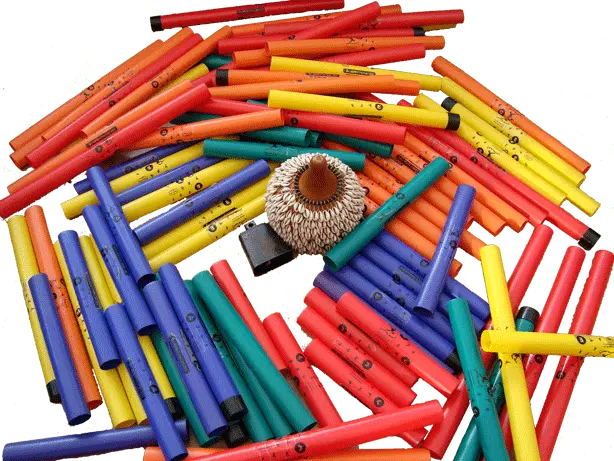
Boomwhackers are colourful, tuned tubes that produce different notes when struck. Their simplicity makes them a very visual and accessible tool for introducing musical elements.
In an activity with Boomwhackers, each student can have a role within a small orchestra. One person can produce a particular note while other participants add different notes until they build a rhythm, harmony or melody.
This type of activity has a very interesting characteristic: each participant has a role in the final result. If one part does not come in at the right time, the musical structure changes.
This makes it possible to work practically on concepts such as listening, individual responsibility and coordination with others.
Rhythm and group dynamics
Rhythm can also serve as a starting point for creating activities in which students have to react, memorise patterns, follow instructions or take on different roles.
In this type of activity, the playful element is important. Students participate, make mistakes, try again and discover that mistakes are also part of the learning process.
What ages are music workshops suitable for?
There is no single appropriate age. What is important is to adapt the methodology and level of difficulty to the group.
With younger students, activities can be based on simple movements, repetition, rhythmic games and short patterns.
With older primary school students, sequences with different levels of difficulty, simple polyrhythms, collective creations or instruments such as Boomwhackers can be introduced.
With teenagers and secondary school students, the workshop can incorporate more complex challenges, improvisation, collective composition or activities in which participants take a more active role in the creative process.
For this reason, before hiring a workshop, I recommend explaining to the professional the students’ age, the number of participants and the specific objective of the activity.
What should you consider before hiring a music workshop for schools?
Not all musical activities have the same objectives. To choose one, it is useful to ask yourself a few questions.
What is the objective of the activity?
Do you simply want to offer a different musical experience? Do you want to work on group cohesion? Are you looking for an activity for a special event? Do you want to introduce students to rhythm and percussion?
Being clear about the “why” will help you select the right type of workshop.
How many students will participate?
The number of participants has a major influence on the dynamics. An activity designed for 15 students may require a different methodology if 60 students participate.
That is why it is important to always communicate the approximate number of students before hiring the activity.
How old are they?
A workshop for 8-year-old students is not designed in exactly the same way as a workshop for teenagers.
Age influences the type of exercises, the length of explanations, the complexity of the patterns and the level of autonomy that can be given to participants.
What space do you have available?
It is also important to take the physical space into account. Some activities require participants to be able to move freely.
In the case of body percussion, for example, having a spacious area without obstacles makes it considerably easier to run the session.
Do you need to have instruments?
Not necessarily. Some activities use the body itself as an instrument, while others incorporate specific materials.
This is one of the questions worth asking before booking the activity: what does the workshop provide and what does the school need to prepare?
What is a music workshop session like?
Each professional has their own methodology, but a participatory session can follow a structure similar to this:
- Introduction: the activity is introduced and students are told what they will do.
- Warm-up: simple movement, pulse or coordination exercises are carried out.
- Learning: musical patterns or activities are progressively introduced.
- Practice: students experiment with what they have learned.
- Collective creation: different patterns or groups are combined to create a piece or shared experience.
- Closing: the result is shared and the experience is briefly reviewed.
This structure can be adapted according to the students’ age, the time available and the school’s objectives.
One-off workshop or ongoing music project?
A one-off workshop can be an excellent option for celebrating a special event, complementing an educational activity or offering students a different experience.
However, it is also possible to develop a longer-term project.
When a rhythmic activity takes place over several sessions, new concepts can be introduced progressively and the level of difficulty can be increased. Students have more time to become familiar with the methodology and can also take on greater responsibility in the musical creation process.
Therefore, the question is not whether one option is better than the other, but what the educational centre needs.
Why work with rhythm through a participatory approach?
Rhythm has a characteristic that I find particularly interesting: it forces us to relate to time and to the people around us.
When we make music together, we cannot act completely independently of others. We have to listen, wait, come in at the right moment, adapt and maintain our part.
This experience can create learning situations that are very different from those that occur in a conventional classroom.
For me, this is one of the great strengths of working with rhythm in education: students do not just learn about music; they learn by making music with others.
My rhythm activities for schools and secondary schools
I have been working with music, rhythm and movement for years, and I have developed activities designed to allow participants to experience rhythm in a direct, participatory and accessible way.
For educational centres, I adapt the activity to the students’ age, the number of participants, the available space and the objectives of the activity.
Among the activities that can work particularly well in an educational setting are body percussion, Boomwhackers and other activities based on rhythm and collective participation.
My goal is not simply for students to “have a good time”. I want them to experience a musical activity in which they can participate, experiment, make mistakes, listen to one another and discover that they can create something together.
Frequently asked questions about music workshops for schools
Do students need to have previous musical knowledge?
No. One of the characteristics of this type of workshop is that it can be designed so that participants start from scratch. The activities can be adapted to the level and age of the group.
Is a music workshop only suitable for music classes?
Not necessarily. Although it has a clear musical dimension, a rhythmic workshop can also develop coordination, listening, participation, body expression and cooperation. That is why it can be integrated into different educational contexts.
Can you run a workshop for an entire year group?
Yes. The activity can be adapted to both small and larger groups, as long as the methodology and available space are defined in advance.
Do you need a music classroom?
Not always. Some activities, such as body percussion, do not require instruments. The most important thing is to have a safe space that is suitable for the type of activity being carried out.
Can the workshop be adapted to different ages?
Yes. The exercises, rhythms, instruments and level of difficulty can be adapted according to the age and characteristics of the group.
How long does a music workshop last?
The duration depends on the type of activity and the school’s objectives. A session can be a one-off activity or form part of a multi-session project. Before defining the proposal, it is advisable to consider the number of students, their age and the time available.
Conclusion: what should a good school music workshop include?
A good music workshop for schools should not simply consist of bringing instruments into the classroom and playing them.
The key is to create a meaningful experience adapted to the students and the school’s objectives.
It should allow students to participate, experiment and learn. It should have a methodology appropriate to the students’ age and the number of participants. And, above all, it should make music stop being something that is simply listened to and become something that is experienced and created together.
If you are looking for music activities for schools and secondary schools in Barcelona or Catalonia, tell me what you need and I will prepare a proposal adapted to your centre, the number of students, their age and the objectives of the activity.
Contact me and let’s talk about your music workshop
Rhythm can be much more than music: it can be a way to listen, coordinate, create and connect with others.