



Confined
In March 2020 we were confined at home. A mysterious virus was threatening the population and the authorities considered it necessary to lock everyone inside their homes.
Suddenly, the professional projects in the cultural sector (not to mention essential ones) of millions of people were compromised. I myself doubted whether I would be able to continue performing concerts. Moreover, what would happen to the percussion classes I gave every day?
These uncertainties, combined with a deep personal crisis, led me to seek new ways of musical expression and to use music as a unifying element for groups of people.
Those months made me ask myself a question that I still remember today: what role will musicians have in a world where technology increasingly takes over functions and live music could disappear overnight?
I came to a conclusion that still guides my work today: whatever happens, people will continue to need to meet, share experiences, sing, move, and create rhythm together.
A friend told me about a method, TaKeTiNa. In short, he explained that it combined mindfulness, rhythm, and movement. I was immediately drawn to it. When movement restrictions became more relaxed, I signed up for an introductory weekend with its creator, Reinhard Flatischler, in Vienna. It was September 17th, 2021. Rarely had I felt such a strong need to travel.
Time to travel
Entering Austria was exhausting: very strict restrictions nearly jeopardized the adventure. Loaded with patience, masks, and the famous PCR test in hand, I landed in Vienna.
Getting to the private house where the activity took place was not easy. It was in the furthest part of a small village west of Vienna: Purkersdorf. As soon as I arrived, I was warmly welcomed by Reinhard and his wife and assistant Anna.
The house was unique: a two-story building, modern and bright, full of large windows and wooden terraces, surrounded by extensive gardens with cabins over three hundred years old, scattered here and there and now uninhabited.
We introduced ourselves to the rest of the participants in a very warm room filled with percussion instruments everywhere: giant Taiko drums, ancient Japanese art.
The other participants came from different European countries, all united by a sense of curiosity and nervousness at the same time. There was a special guest: Estas Tonne, a virtuoso Ukrainian guitarist, very famous in Austria, Germany, and surrounding countries.
The real journey
After a brief introductory talk, we began the first TaKeTiNa “journey.” Within a short time, we were synchronized in a blend of different rhythms of feet, hands, and voices.
We spent the entire day like this, one journey after another. I call it a “journey” because when someone begins a TaKeTiNa exercise, they are truly starting a TaKeTiNa experience into the physical, psychological, and spiritual depths of themselves.
The physical aspect
Physically, TaKeTiNa is based on a series of specific body movements, mainly the legs, and the recitation of various syllables with the voice. All of this is done in a group forming a circle.
The movements are lateral or forward and backward, always very smooth, without any abruptness. These movements subtly develop balance and help build awareness of the body. Within minutes, it becomes a mindless movement, “that goes by itself.”
The beginning of the exercise is the voice, the continuous repetition of specific syllables that help connect with oneself and with the group. Then body movement is added. Once these two elements are consolidated, hand clapping is incorporated. We now have three layers: feet, hands, and voice. Later, leader improvisations are added that guide the group into a deeper state of connection.
The psychological aspect
Psychologically, the TaKeTiNa universe is infinite. Here, the personal aspects of each participant come into play and are reflected in the group experience.
Some people are afraid of making mistakes, others project their errors onto others. These dynamics often reflect everyday patterns.
One of the core principles of the method is that “what is transformed inside the circle improves outside.”
The spiritual aspect
Spiritually, there are also no limits. The experience can be related to mindfulness or meditation practices, always through rhythm and the body.
Several experiences of fullness have remained engraved in my memory, where the body moved by itself while performing complex polyrhythms of feet, hands, and voice.
During one of my stays in Vienna, after the training, I arrived home with a sensation of continuous energetic flow lasting several days.
Training
I am already anticipating what came after that introductory weekend. After getting to know the system and its creator in Vienna, I decided to go deeper.
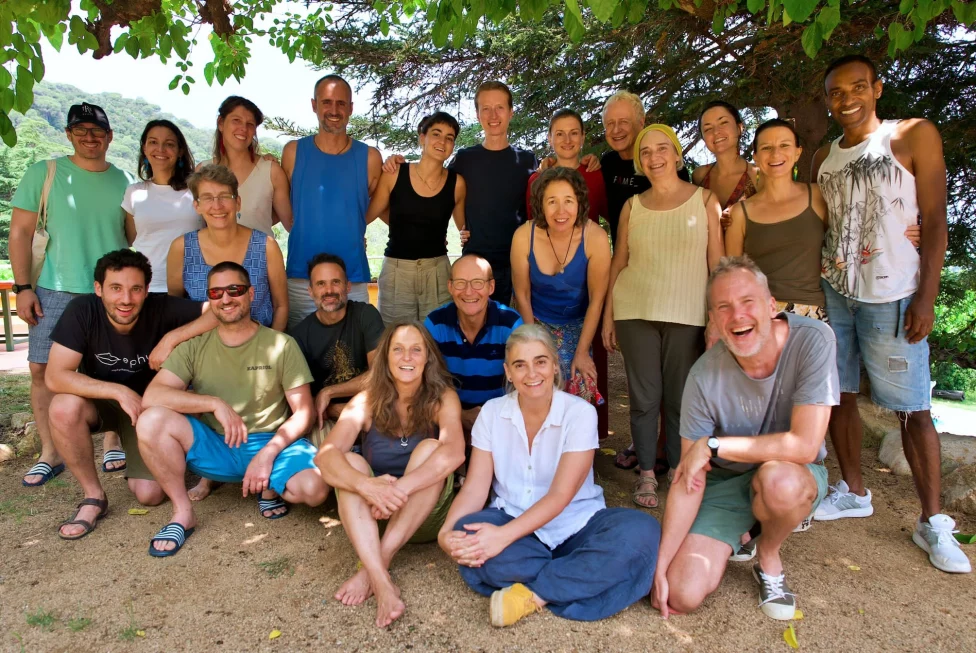
A few weeks later, I invited Reinhard and his wife to Catalonia to lead a four-day TaKeTiNa retreat at Can Benet Vives, in the Montnegre Natural Park.
It took place from July 11th to 14th, 2022, with participants from 10 countries and 3 continents.
During that retreat, I decided to undertake the TaKeTiNa instructor training, a two-year process.
During this time, I traveled to Vienna for two weeks every four months.
It was intense and enriching. In parallel, I continued organizing an annual retreat at Can Benet Vives.
Currently
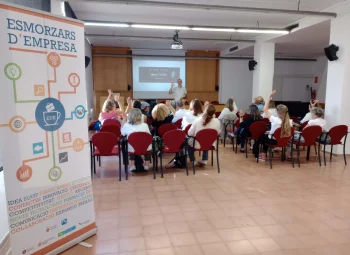
I have incorporated the TaKeTiNa knowledge acquired into the services I offer to companies through Corella Music Experience.
When I started working with corporate teams, I realized that many of the TaKeTiNa principles aligned with the goals of group work.
People often arrive stressed, scattered, and immersed in the pace of daily life. Before building a percussion piece or working on cohesion, it is necessary to reconnect with oneself.
This is where TaKeTiNa principles provide extraordinary value. Through pulse, movement, and voice, participants enter a state of shared attention.
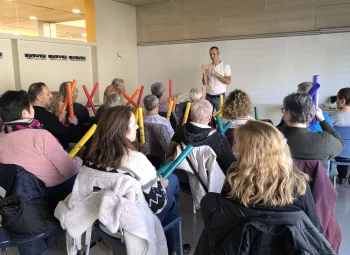
From this point, body percussion, Boomwhackers, drum circles, and coaching dynamics acquire a completely different depth.
For this reason, TaKeTiNa is no longer an independent activity within my work: it is the inspiration that prepares the ground so that the experience has a much greater impact.