


A percussion team building activity for corporations is a group experience in which dozens of people, with no previous musical knowledge, create rhythms together using their bodies, sound tubes or drums. It works particularly well in large companies because it requires participants to listen, coordinate and pursue a common goal in real time, breaks down barriers between departments and hierarchies, and can be adapted to groups of dozens of people, indoor or outdoor spaces, and formats ranging from an hour and a half to several days.
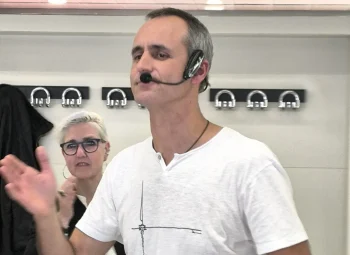
I’m Ignasi Corella, and for years I’ve been bringing rhythm to all kinds of teams in Barcelona and across Catalonia. In this article, I explain from practical experience why percussion fits so well with the needs of a large organization, what formats are available, and what you need to consider to organize it without surprises.
What is a percussion team building activity for corporations?
It is a group experience guided by a facilitator in which rhythm is the working tool. It is neither a concert nor a music class: the participants are the protagonists, and the final result (a body percussion choreography, a melody created by everyone, or a drum circle) only works if the team works as a team.
In the context of large companies, this type of activity has three characteristics that set it apart from other proposals:
- És inclusiva de veritat: no depèn de la forma física, de l’edat ni de saber música. Tothom pot participar des del primer minut.
- És escalable: el ritme funciona igual amb un grup petit que amb una sala plena de gent.
- Deixa una vivència compartida: el so col·lectiu és immediat i tothom percep quan el grup està sincronitzat i quan no.
Why do large corporations need a different type of team building?
Quan una empresa creix, la connexió entre persones es complica. Hi ha equips que treballen en seus diferents, departaments que gairebé no es coneixen, persones que s’acaben d’incorporar i estructures jeràrquiques que, sense voler-ho, frenen la comunicació. Les activitats de team building per a grans empreses han de respondre a aquesta realitat, i no sempre ho fan.
Many classic activities (scavenger hunts, physical challenges, competitive games) work well with small, homogeneous groups, but with large and diverse groups they tend to leave people out: those who are uncomfortable competing, those with physical limitations, or those who simply prefer to observe. Percussion approaches the challenge differently: the goal is not to beat anyone, but to sound good together.
In corporations, I also frequently encounter very specific needs:
- Integrate teams following a merger, reorganization or rapid growth.
- Welcome new team members in a way that makes them feel part of the group.
- Open or close a convention, internal conference or strategy day with energy.
- Work on values such as active listening, shared leadership and adapting to change through direct experience.
- Reduce tension during high-stress periods, such as year-end or product launches.
What does science say about playing rhythms in groups?
La intuició que el ritme uneix té base científica. A study published in Scientific Reports by researchers from Bar-Ilan University analyzed 51 groups of three people while they played drums together. The results showed that, during the activity, the intervals between group members’ heartbeats tended to synchronize, and that both this physiological synchrony and synchrony while playing predicted a greater perception of group cohesion. In addition, groups with greater physiological synchrony coordinated better in a subsequent free-improvisation task.
Caution is needed: this is a laboratory study with small groups, and the authors themselves indicate that the findings are particularly relevant to newly formed groups. But that is precisely what happens in many corporations: teams that barely know each other and need to build trust quickly. In my experience, this is exactly what you see in the room when the group “finds” the rhythm.
What benefits does percussion bring to a corporate team?
These are the benefits I observe most often and that companies mention to me after the sessions:
- Improved communication: per tocar junts cal escoltar abans de fer. Aquesta escolta activa es trasllada després a les reunions.
- Cross-department cohesion: when someone from sales, someone from finance and someone from IT share a rhythm, labels fade away.
- Shared leadership: in several activities, volunteers lead the group. Natural leadership qualities often emerge that are not visible in the office.
- Creativity: improvisation and creating an original melody within a limited time stimulate the ability to contribute ideas.
- Managing mistakes and adapting to change: making mistakes is part of the process. The group learns to recover the rhythm without looking for someone to blame.
- Well-being and stress reduction: movement, voice and collective sound help release tension in an enjoyable way.
- Connection with CSR: these activities can be aligned with several Sustainable Development Goals (SDGs 3, 4, 8, 10 and 17) as part of a Corporate Social Responsibility strategy.
What percussion team building formats are available?
Not all teams or objectives need the same approach. These are the disciplines I regularly work with:
Body percussion
The body becomes the instrument: clapping, tapping the chest and legs, and stepping. After learning the basic patterns, the group creates choreographies to well-known songs. It develops coordination, memory and cohesion, and only requires a spacious area free of obstacles.
Boomwhacker Orchestra
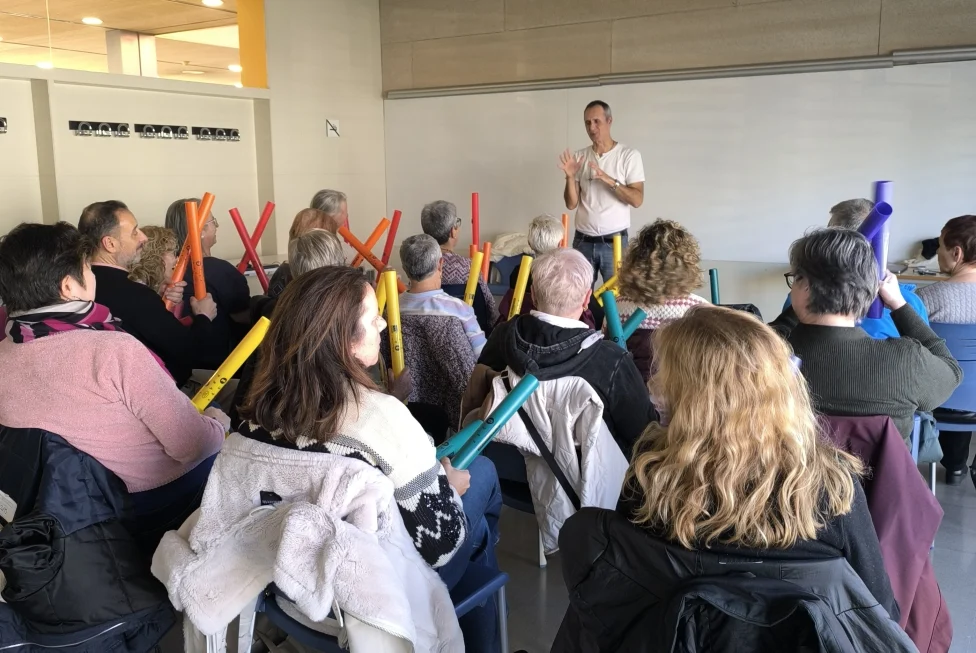
Boomwhackers are tuned, color-coded tubes, each producing a different note. Because the notes are distinguished by color, learning is intuitive. Participants form an orchestra, divide into groups that create their own melody within a limited time, and some volunteers even conduct it. It is ideal for developing listening, collaboration and leadership.
Drum circle
Instruments com el djembé o la darbuka es distribueixen en cercle. El grup construeix un ritme comú i, amb lideratge rotatiu, diferents persones n’agafen la direcció. Genera una sensació d’harmonia i unió molt potent.
Taketina
It is a system that could be described as mindfulness through rhythm and movement. It combines voice, steps and clapping to bring the group into a state of attention and body awareness, ending in a deep sense of relaxation. It works particularly well for well-being days or leadership retreats.
To see how I combine these disciplines in a proposal designed specifically for companies, you can explore Corella Music Experience, my musical team building programme.
Format comparison table
| Format | Approximate duration | Approximate number of participants | Ideal for |
|---|---|---|---|
| Body percussion | 60–90 min | Up to 50 people | Opening sessions, energy and coordination |
| Boomwhacker Orchestra | 90 min | 15–50 personas | Active listening, creativity and leadership |
| Drum circle (3 disciplines) | 2–3 horas | 5–25 personas | Deep cohesion and shared leadership |
| Taketina | From 3 hours to 3-day retreats | 10–60 personas | Well-being, mindfulness and resilience |
| Multi-day programme with coaching | 2 o 3 días | A consultar | Management teams, shared vision and purpose |
The group size for each format is approximate. In combined proposals, the experience can be adapted to large groups of up to 100 people. If your event exceeds this number, let’s discuss it and explore the format that best fits.
How does it adapt to large groups and corporate events?
When I work with corporations, the key is advance planning. A large group is not simply a small group multiplied: you need to consider the room layout, the timing of each block and how to make sure nobody is left in the background. Some of the resources I use include:
- Combined blocks: start with body percussion (it requires no equipment and activates everyone at the same time) and then move on to instruments.
- Subgroups with their own challenge: each subgroup creates its part and, at the end, they come together in a shared piece. It is a clear metaphor for how a company works.
- Rotating leadership: several people take on the role of conductor, allowing leadership to be explored in front of the whole group.
- Adapted language: sessions can be delivered in Catalan, Spanish or English, an important detail for international teams.
If the objective goes beyond a single day and you are looking for a transformation process involving team coaching and several days of work, I recommend the programme Ritmes que transformen, which I develop together with psychologist and coach Álvaro Pérez Pooley.
How to organize a percussion team building activity step by step?
This is the process I follow with companies to ensure that the activity has meaning and impact:
- Define the objective: integration, motivation, leadership, well-being or celebration. The objective determines the format.
- Define the group: number of people, profiles, languages and any accessibility requirements.
- Choose the format and duration: from a 90-minute session to a half-day or multi-day programme.
- Choose the venue: a spacious room free of obstacles, with one chair per participant when necessary. It can also be an outdoor space or a natural setting.
- Fit it into the schedule: at the beginning of a day, it energizes the group; at the end, it helps bring the day to a positive close.
- Experience it: I provide all the instruments and facilitation; the team only needs to come ready to participate.
- Reflect and connect it to everyday work: each session ends with a shared reflection to transfer the learning to the workplace.
Where can a team building activity be held in Barcelona and Catalonia?
I organize team building activities in Barcelona and throughout Catalonia. Sessions can be held at the company’s own facilities (a training room, auditorium or multipurpose space), in hotels and convention centers, or in natural settings, which are particularly suitable for multi-day programmes. The important thing is to have enough space for the group to move comfortably.
Common mistakes in corporate team building
After many sessions, there are some recurring mistakes that are worth avoiding:
- Choosing the activity before defining the objective. If you do not know what you want to achieve, it is difficult to measure whether it has worked.
- Thinking only about the most extroverted people. A good activity must also work for more reserved people.
- Fitting it into a gap in the schedule without allowing time for a closing reflection. The final reflection is what connects the experience with the workplace.
- Underestimating the space required. A large group in a small room loses energy and comfort.
- Doing it once and then forgetting about it. Cohesion is built through continuity, not through a single event.
Frequently asked questions about corporate team building
Do you need to know music to participate in a percussion team building activity?
No. The activities are designed so that anyone can participate from the very beginning, without previous musical knowledge.
How many people can participate?
It depends on the format. Some activities are designed for groups of 15 to 40 people, while combined proposals can be adapted to large groups of up to 100 people.
How long does a percussion team building activity last?
The formats are flexible: from 90-minute workshops to half-day sessions, and 2- or 3-day programmes for deeper processes.
Does the company need to provide equipment?
No. We provide all the necessary instruments and equipment. The company only needs to provide a suitable space.
Can it be customized according to the company’s objectives?
Yes. The content can be adapted to work on leadership, communication, change management or the integration of new teams.
In which languages are the sessions delivered?
In Catalan, Spanish and English.
Key takeaways
- A percussion team building activity for corporations brings together people from different departments and levels without requiring musical knowledge.
- Scientific research has linked synchronized rhythm playing with a greater perception of group cohesion.
- There are formats for different objectives: body percussion, Boomwhackers, drum circles, Taketina and coaching programmes.
- The key to success is defining the objective, planning the logistics carefully and allowing time for a final reflection.
Would you like to bring rhythm to your company?
If you are looking for a different, inclusive activity with a real impact on your team, let’s talk. Together, we will design the experience that best fits your objectives, group size and available space.
Contact me and tell me what you need.