


Our biology indicates that the voice was the first form of human expression to appear. Percussion came shortly after. Little by little, these two natural resources evolved into complex systems of communication and art. We can say that music was the first human art. Cultures have been found that do not use painting or sculpture, but none has been found that does not have music—whether it is a simple lullaby, a simple and repetitive ritual chant, or the most sophisticated symphony of multiple voices and timbres.
This shared origin helps us understand the benefits of combining voice and body percussion, two tools that are part of our deepest nature.
The “Why” of using body percussion and the voice
In their origins, the purpose of body percussion and the voice was not entertainment, as often happens today; the purpose was to strengthen the survival of the group: to create cohesion and synchronization. They were also used in rituals and served as a form of communication within the community and between communities.
It is worth noting that rhythm and the voice are already embedded in the body from the very beginning of conception. A simple cardiac auscultation a few weeks into fetal life reveals the accelerated and hypnotic rhythm of the baby’s heart.
Later on, we find rhythm in breathing, in walking… The voice enters the scene with the first cry we make when we are born. Body percussion itself appears later, when we begin to express ourselves by saying “this is me,” striking our chest, or clapping when we celebrate something.
Rhythm is probably the oldest technology we have for creating cohesion among humans. A shared rhythm generates trust—an essential factor in building a community capable of ensuring the survival of the species. Here we find one of the great benefits of combining voice and body percussion: generating real cohesion through shared rhythm.
How I apply voice and body percussion in my activities
In the activities I offer that include body percussion, boomwhacker tubes, and drum circles, I use the voice because it is the element that connects and unifies us the most. There is no need to sing or play anything complicated; it is enough to do it together and harmoniously.
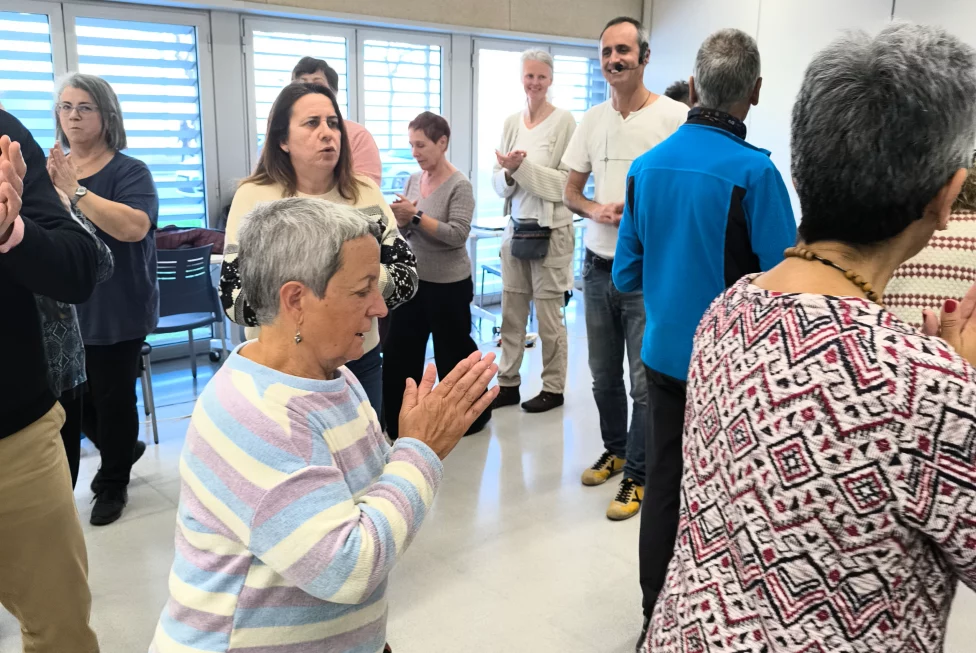
In a body percussion activity, we begin with simple patterns by striking our chest (reaffirming “this is me and I am here”) and clapping (a symbol of celebration). We can increase the difficulty slightly by stomping our feet on the ground (we all long to root ourselves). The incorporation of two new limbs into the rhythm equation exponentially increases the complexity of a pattern (“pattern” being a sequence of specific strikes arranged in a chosen order) involving hands and feet. From here, the voice comes into play: short and simple phrases that everyone can articulate and sing. This is where the magic can appear: communion, connection, creativity, presence, and enjoyment.
Cultures that have developed an extraordinary rhythmic level for millennia
Continuing with the close connection between the voice and musical expression with instruments, we find in cultures such as the Hindu tradition—with thousands of years of musical heritage—that everything intended to be expressed musically is first sung. Afterwards, the performer transfers this melody or rhythmic pattern to the instrument, whether it is a tabla, a sophisticated percussion instrument that requires intense study just to begin uncovering its secrets, or a string instrument such as the Rudra Veena. In the traditional approach, no one would think of giving a drum to a child and letting them do whatever they like. No. In musically complex cultures with a long evolution spanning millennia, such as the Hindu tradition, one must first learn to sing the ancestral melodies before transferring them to the chosen instrument.
Also related to the voice and percussion, in Africa we find the batá drums. For the people of the southwest region (the Yoruba people, today living in Togo, Nigeria, and Benin), these drums express the voice of Ayan, the great spirit of the drum. When they listen to a piece played on batá drums, they do not hear “drums being played”; they hear the Great Spirit “speaking,” literally.
Conclusion
Cultures that since ancient times have developed rhythm most deeply have not related to it as a technique to be learned, but as a way of organizing consciousness—and the voice is the best starting point.
Understanding the benefits of combining voice and body percussion from this perspective allows us to go beyond technique and enter the realm of connection, presence, and real cohesion.
With this reflection in mind, I design the team-connection activities that I offer: Corella Music Experience, Vital Rhythm, Rhythms that Transform, Body Percussion and Boomwhackers.