



As a specialist in rhythm, music pedagogy, and activity facilitation, I know that rhythm activities for children and teenagers play a fundamental role in the development of children and teenagers. This article will help you understand why they are so important, what benefits they offer—both physically and cognitively and emotionally—and how you can easily integrate them into your daily life or into educational and leisure programs. You will also find resources, activity examples, and useful links to explore the topic further.
What are rhythm activities?
Rhythm activities involve movement, music, and sound patterns that make children’s bodies and minds work together. It is not just about listening to music, but about actively participating in the creation of sounds, movements, and rhythmic patterns. Through beat patterns, clapping, instruments, or body percussion, children learn to listen, synchronize, and express themselves.
These types of activities can be carried out in a structured way (such as in workshops or classes) or spontaneously, as games led by educators and families. The benefits are numerous and are supported by studies in music education and child development.
Benefits of rhythmic activities for children and teenagers
Scientific and pedagogical evidence shows that rhythm activities offer advantages far beyond simply “making music.” Some of the main benefits of rhythm for children include:
Cognitive development
- Improvement of memory and attention span, especially for following sequences and patterns.
- Promotion of phonological awareness and language skills, as rhythm and language are closely connected.
- Introduction to mathematical concepts such as rhythm, fractions, and pattern counting.
Coordination and motor skills
- Development of coordination between hearing and movement, as well as muscular control.
- Improvement of balance and fine and gross motor skills through age-appropriate activities.
Emotional and social aspects
- Encouragement of self-expression and emotional expression, helping children manage their feelings.
- Teamwork and cooperation are required when rhythm activities are carried out in groups.
- Increased self-esteem and confidence through active participation and success in musical games and dynamics.
Ideas for rhythm activities for children and teenagers
Below is a selection of inspiring activities, ranging from the simplest to more elaborate proposals, ideal for different ages and educational or family contexts.
1. Simple rhythm games
These games are easy ideas that you can adapt to a group of children or teenagers:
- Clap-Rhythm Echo: one participant performs a clapping pattern, and the rest must repeat it.
- Follow the leader: walk or move to the rhythm of the music, and the others must imitate the steps.
- Create your own beat: use everyday objects (tables, cans, sticks) to create cooperative rhythms.
2. Body percussion
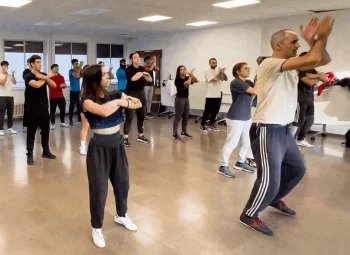
Body percussion is a powerful way to make music using the body itself: clapping hands, stomping feet, whistling, or tapping knees become instruments. This activity helps synchronize children and teenagers in real time and builds self-esteem. In addition, it is a fully accessible and fun activity for all ages.
If you are looking for a guided experience with body percussion as part of a specialized workshop, you can check out the Boomwhackers proposal. This type of dynamic allows you to combine rhythm with coordination, active listening, and creative expression.
3. Boomwhackers for children
Boomwhackers are tuned tubes that produce notes when gently struck. They are ideal for children because they are easy to use, encourage cooperative work, and allow playful and immediate exploration of melodies and rhythms.
You can organize a mini boomwhacker orchestra where each participant has a role and must follow their rhythmic pattern to build a collective piece.
If you are interested in a structured boomwhacker activity, on Ignasi Corella’s website, you will find a specialized activity that can be adapted for children and teenagers.
4. Body movement and rhythm exercises
Games that include physical movement help participants connect rhythm with their own bodies. For example:
- Tempo march: walking to the rhythm of different songs.
- Freeze Dance: dance, and when the music stops, everyone must freeze.
- Rhythm and movement sequences: combine dance steps with simple rhythmic patterns.
5. Rhythm and emotion
A creative way to work on emotional expression is to use different musical tempos or intensities so that children represent emotions with their bodies and sounds. For example:
- Slow rhythms → calmness
- Fast rhythms → excitement or joy
- Irregular patterns → surprise
This type of game helps develop awareness of emotion and the body, and is a powerful resource for teenagers who want to explore their inner expression.
How to adapt activities to different ages
Rhythm activities can be adapted according to age, so they are effective for everyone:
- Early childhood (3–6 years): simple clapping and movement activities, focused on sensation and immediate response.
- Children (7–10 years): introduction of longer patterns, more complex coordination work, and group games.
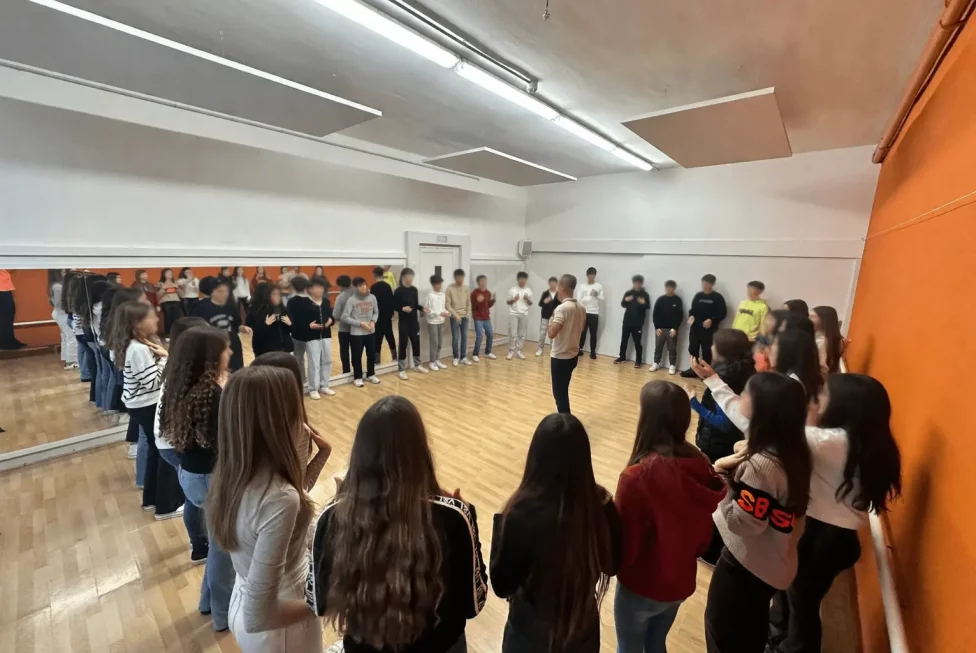
- Teenagers (11+ years): collective rhythmic projects, combining music and body expression with creative and choreographic elements.
Tips for facilitating rhythm activities
Here are some tips that can help make your rhythm activities more effective and engaging:
- Start with short warm-ups to activate attention and the body.
- Alternate structured moments with spaces for creative freedom.
- Use simple materials, such as sticks, small instruments, or recycled materials.
- Encourage active listening and respect for others’ rhythms.
Studies and external resources
If you want to explore further the effects of rhythm activities on child development, I recommend this article with scientific evidence on how rhythmic synchronization enhances executive functions and cognitive skills in children:
How Rhythm Synchronization Boosts Executive Function in Preschoolers: A resource that explores how rhythms affect attention, memory, and emotional regulation in young children.
Conclusion
Rhythm activities for children and teenagers are much more than musical games: they are pedagogical and creative tools that enhance cognitive, motor, emotional, and social skills. Whether you use them at home, at school, in after-school programs, or in workshops, they can offer memorable and transformative experiences for children and teenagers.
As a rhythm and music professional, I encourage you to incorporate these practices progressively, adapted to the ages of the participants and always with joy and curiosity. Rhythm is everywhere; you just need to listen and participate.