


Meetings are an essential part of the daily life of any organisation. However, it is common for many of them to begin with a distant atmosphere, low participation or limited energy, making communication and creativity more difficult. Incorporating corporate music activities is a simple and effective way to transform those first minutes into a participatory experience that encourages trust and connection between people.
Music is a universal language that facilitates communication without requiring extensive musical knowledge. When combined with group activities, it becomes a powerful tool for creating a positive atmosphere, reducing tension and enhancing collaboration.
In this article, you will discover various proposals that can be adapted to teams of all sizes, both for in-person meetings and for corporate events, conventions or team building sessions.
In summary: what do corporate music activities bring to a company?
- They encourage participation from the very beginning.
- They improve communication between team members.
- They reduce the initial tension in meetings.
- They increase creativity and the ability to generate ideas.
- They strengthen cohesion and the sense of belonging.
- They create shared experiences that are remembered for a long time.
Why is music so effective as an icebreaker?
When a group of people shares a musical experience, natural synchronisation takes place. Age, job position or professional experience do not matter: following a common rhythm helps create a sense of unity that is difficult to achieve through a conventional presentation.
Unlike other activities, musical dynamics involve movement, active listening, coordination and cooperation. This combination of elements helps create a much more relaxed environment and encourages participants to communicate more easily.
According to various studies on music psychology and teamwork, sharing rhythmic activities promotes trust and strengthens social relationships within groups.
For this reason, more and more companies are incorporating corporate music activities into meetings, conventions and team development activities.
When is it recommended to use these activities?
There is no need to wait for a large annual convention. Musical activities can be incorporated into many different situations:
- Department meetings.
- Project kick-offs.
- Corporate conventions.
- Training sessions.
- Innovation workshops.
- Sales presentations.
- Welcoming new employees.
- Meetings between teams from different offices.
The goal is not to create a concert, but rather to create a shared experience that helps people connect in a different way.
10 musical activities to break the ice in meetings
1. Rhythm circle
One of the simplest proposals consists of forming a circle. One person starts a very simple body rhythm using their hands or feet. Gradually, the rest of the group joins in until everyone is maintaining the same pattern.
This activity develops active listening and visually demonstrates how coordination emerges when everyone shares the same goal.
2. Rhythm-based introductions
Instead of doing the typical round of introductions, each participant says their name while following a simple rhythmic pattern. The rest of the group repeats it.
This small activity helps people remember names, creates smiles and removes the usual tension from the first few minutes.
3. Body percussion
Body percussion is one of the most versatile activities because it requires no instruments. Through clapping, footsteps and gentle taps on the chest or thighs, surprising compositions can be created.
When I work with companies, this is one of the activities that works best because everyone can participate regardless of their musical experience.
If you want to discover how I adapt this methodology for professional teams, you can check my Body Percussion activity.
4. Building a collective rhythm
Each person contributes a small rhythmic sequence. Once all contributions have been defined, they are combined to create a shared composition.
It is a powerful metaphor for how teams work: each member contributes a different piece, but it is the sum of all contributions that generates a much richer result.
5. Boomwhackers to encourage coordination
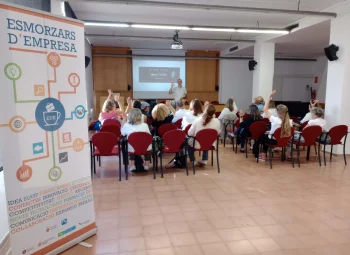
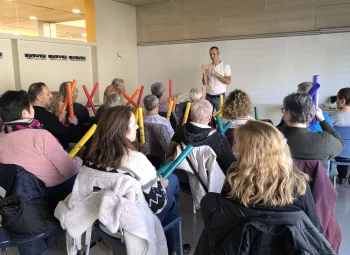
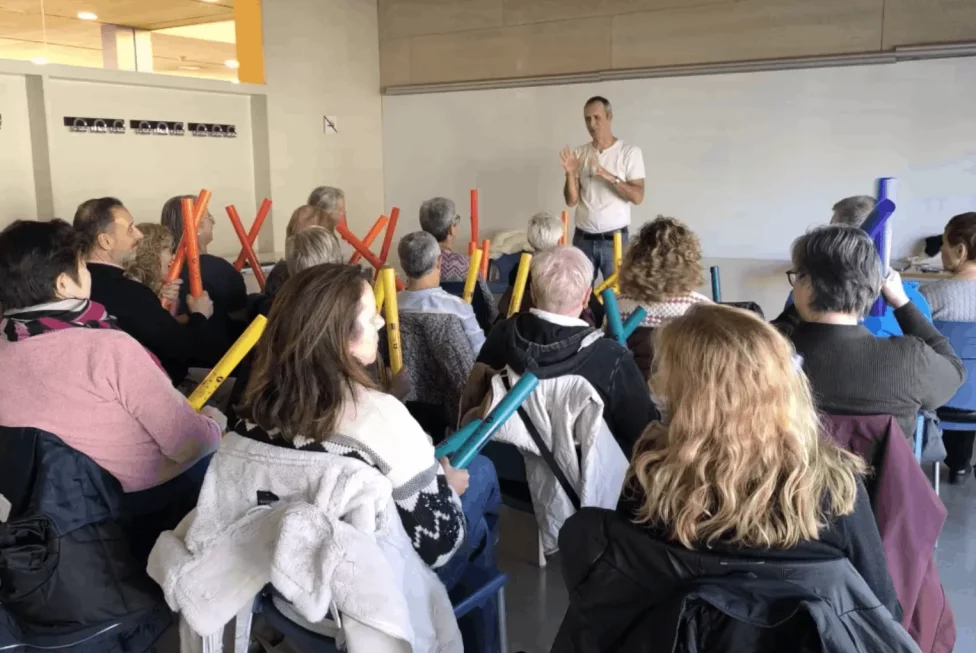
Boomwhackers are colourful musical tubes that allow participants to create melodies without needing any previous musical knowledge.
Their simplicity means that participants focus on listening to their colleagues and coordinating with each other rather than worrying about playing correctly.
In my Boomwhackers sessions, this tool becomes a fun experience that strengthens communication and cooperation.
6. The invisible conductor
One member of the group leads changes in intensity, speed or rhythm without speaking. The rest of the group can only interpret their gestures.
This activity highlights the importance of non-verbal communication and observation within teams.
7. Rhythms in pairs
Participants work in pairs, reproducing very simple rhythmic sequences. Afterwards, they switch roles.
This proposal makes it easier for people who do not usually work together to establish an initial connection in a relaxed environment.
8. Guided improvisation
Improvisation is a very useful tool for encouraging creativity and confidence. In this activity, the group receives very simple guidelines —such as maintaining a constant pulse or alternating different body sounds— and from there builds a small collaborative musical piece.
The goal is not to achieve a perfect performance, but to experience the importance of listening to others, adapting to changes and making decisions together. This type of activity helps people overcome the fear of making mistakes and encourages a much more open attitude towards everyday challenges within the company.
9. The rhythm of values
Each team chooses between three and five values that they consider essential within the organisation, such as trust, innovation, respect or commitment. Then, each value is associated with a specific movement or rhythmic pattern.
When all groups share their proposals, a final composition is created representing the company’s shared values. It is an original way of turning abstract concepts into a practical experience that participants can easily remember.
10. Final group performance
After several activities, the group is ready to perform a small collective piece. This activity makes the entire learning process visible and reinforces the feeling of having achieved a shared goal.
The complexity of the composition is not important. The most valuable aspect is seeing that people with very different backgrounds have been able to coordinate, listen to each other and build something together in a very short time.
What benefits do these activities bring to teams?
Corporate music activities go far beyond a simple game to start a meeting. When they are well designed, they help develop skills that are later transferred to everyday professional life.
Among the most significant benefits are:
- Improved communication between team members.
- Increased participation during meetings.
- Greater active listening ability.
- Development of coordination and cooperation.
- Reduction of initial tension in new groups.
- Encouragement of creativity and collaborative thinking.
- Increased sense of belonging to the organisation.
- Creation of shared experiences that strengthen personal relationships.
Why do icebreaker activities work so well?
When people share a fun and participatory experience, the social barriers that often appear at the beginning of a meeting are reduced. This makes subsequent conversations flow more naturally and helps participants feel comfortable contributing ideas.
Music has a very important advantage compared with other activities: it involves everyone at the same level. No previous knowledge or special skills are required. In just a few minutes, any group can experience what it means to work in coordination and achieve a common goal.
This type of methodology is especially useful for multidisciplinary teams, companies undergoing change processes, annual conventions or events where people who do not usually work together come together.
How I work with these activities in companies
When I design an activity for a company, I adapt each proposal to the team’s objectives. There is no single formula: every organisation has its own culture, needs and participant profiles.
The aim is for music to become a tool to enhance communication, cohesion and trust, always through a participatory experience that is accessible to everyone.
In activities such as Corella Music Experience, I combine rhythm, movement, participation and emotion so that every person becomes an active part of the experience from the very beginning.
Frequently asked questions
Do participants need musical knowledge?
No. The activities are designed so that anyone can participate, regardless of their previous experience with music.
How many people can participate?
The activities can be adapted to both small teams and very large groups, from around ten participants to hundreds of people at conventions or corporate events.
How long does a musical activity last?
It depends on the objectives of the session. It can be a short 10 or 15-minute activity to start a meeting or be part of a more complete workshop lasting one or several hours.
Are they only suitable for team building activities?
No. They are also highly useful for internal meetings, training days, sales presentations, conventions, conferences or onboarding processes for new professionals.
Conclusion
Incorporating corporate music activities is a different way of approaching meetings. When people share rhythm, movement and listening, they also share trust, communication and collaboration.
The best meetings are not necessarily the longest or the most formal, but rather those in which people feel involved from the very first minute. A well-designed musical activity can make that difference and transform a conventional meeting into a memorable experience.
Several studies also indicate that an environment where people feel safe to participate, share ideas and make mistakes without fear encourages innovation and improves team performance. If you want to explore this concept further, you can read this article from Coursera: Understanding Psychological Safety: Why It Matters and How to Create It.